Elderscroll: A Typeface for Legendary Projects
More Than Just Letters on a Page
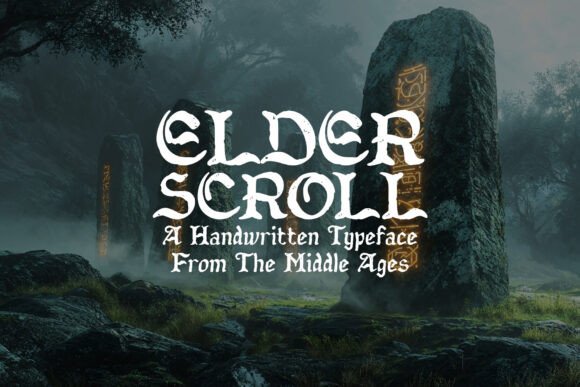
There’s a particular kind of magic in the feel of old paper, the scent of a well-worn book, or the sight of an elegant, time-tested script. In a world saturated with sleek, minimalist fonts, there's a growing hunger for designs that carry a story, a sense of history, and a tangible soul. This is where a typeface like Elderscroll enters the conversation. It’s not merely a set of characters; it’s a vessel for atmosphere. Inspired by medieval manuscripts and the lore of forgotten realms, this handwritten font offers a direct pathway to evoking mystique, tradition, and narrative depth in your work.
At its core, Elderscroll is a display font, meaning it’s crafted for impact rather than extended body text. Its visual personality is unmistakable. You’ll notice a strong, calligraphic influence with deliberate, slightly uneven strokes that mimic the hand of a scribe. The letterforms often feature subtle details—perhaps a gently curved terminal here, a distinctive ligature there—that prevent it from feeling like a generic "old-timey" font. It carries the weight of Old English and medieval aesthetics without becoming illegible, striking a crucial balance between historical flair and contemporary clarity. This isn't a dusty relic; it's a creative font designed for modern application.
Where the Elderscroll Font Finds Its Voice
The true test of any typeface is its versatility. Elderscroll shines in specific contexts where its personality isn't just decorative, but essential to the project's goal. Think of it as a specialized tool in your design assets kit.
- Branding & Logo Design: For businesses that want to communicate heritage, craftsmanship, or adventure, this font is a powerful ally. A craft brewery, a boutique fantasy bookstore, a historical tour company, or a maker of handcrafted leather goods could use Elderscroll in their logo design to instantly establish a narrative. It tells customers, "There's a story here."
- Publishing & Editorial Design: This is its natural habitat. Use it for chapter headings in fantasy novels, as the title font for a historical magazine, or on the cover of a poetry collection. It excels in editorial design where it can set the tone before a single word of the body copy is read.
- Packaging Design: Imagine this font on a label for a special reserve wine, a artisanal coffee blend, or a board game. It adds perceived value and a sense of uniqueness, making the product feel like a discovery.
- Digital & Web Design: Used judiciously, it can create stunning hero sections on websites for authors, musicians, or event promoters. Paired with a clean sans serif font for navigation and body text, it provides a dramatic visual anchor. It’s equally effective for eye-catching social media graphics announcing a new launch or event.
- Personal & Craft Projects: Beyond commercial use, it’s perfect for wedding invitations with a classic theme, custom stationery, or DIY projects like scrapbooking and wall art for a game room.
The Strategic Impact on Your Brand and Audience
Choosing a font like Elderscroll is a strategic decision that influences how your audience perceives your brand on a subconscious level. It directly impacts brand perception and can foster a deeper audience engagement.
First, it establishes visual hierarchy with authority. When used for headlines, it immediately draws the eye and signals importance, creating a clear path for the viewer to follow. This enhances readability in a broader sense—not by being simple, but by organizing information effectively. Second, it builds recognition. A consistent and unique typeface becomes a cornerstone of your brand identity. When customers see that distinctive script across your website, packaging, and social media, it builds familiarity and trust, contributing to a sense of professionalism and intentionality.
A Practical Guide to Choosing and Using Elderscroll
So, how do you determine if this premium font is the right fit? Start by evaluating your project's core message. Does it call for tradition, narrative, and a touch of the epic? If you're designing for a tech startup or a minimalist skincare brand, it's likely not the match. But for the contexts described, it's worth serious consideration.
- Test Font Pairings: This is non-negotiable. Elderscroll is a strong personality, so it needs a partner that complements without competing. The most common and effective strategy is to pair it with a neutral, highly legible serif font or sans serif font for body copy. For example, the elegant structure of a serif like Georgia or the clean lines of a sans serif like Open Sans can provide the perfect counterbalance, ensuring your content remains accessible.
- Review Included Styles: Does the font family include different weights or styles? A commercial font license often includes variations like Regular, Bold, and Italic. Having these options gives you more flexibility within a single project to create subtle hierarchies without introducing a conflicting typeface.
- Conduct Readability Checks: Always test the font at the size and in the medium you intend to use it. A beautiful script can become a tangled mess at small sizes or on low-resolution screens. Zoom in, print it out, and view it on different devices. Legibility is paramount.
- Understand the License: For any commercial project—be it a client's logo, a product you sell, or a monetized website—you must ensure you have the proper commercial license. Reputable foundries are clear about usage rights. This isn't just a legal formality; it's part of professional practice and supporting the craft of type design.
In the end, a typeface like Elderscroll is a bridge to a feeling. It allows a designer to wrap a modern project in the cloak of history, to make a brand feel timeless, or to transform a simple invitation into a scroll of promise. Its value lies not in its complexity, but in its ability to communicate a rich, unspoken story at a single glance. Used with intention and paired wisely, it becomes an indispensable part of a designer's and creator's toolkit for projects that demand more than just words—they demand legend.